
Ivory and the Logic of Greed
Heart of DarknessThis flow traces how Ivory shapes Company ambition, Kurtz’s authority, and the conversion of a landscape into private possession.
increasing Bearing strength in each event
 decreasing
Bearing strength in each eventdecreasingThe Map’s Yellow Region
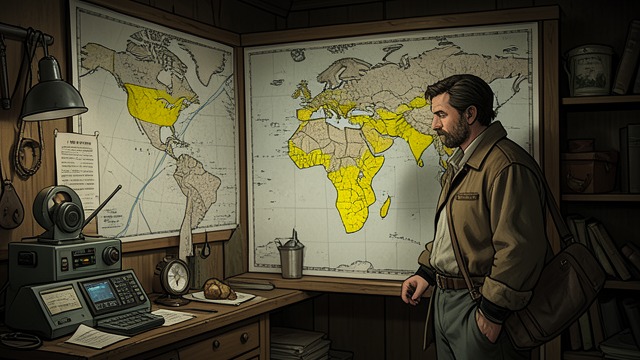
A Territory Coloured for Trade
The Map
Marlow studied a map of the Company’s territories before sailing. The yellow region marked the interior he would enter, and the river ran through it like a compelling route.
From Geography to Commodity
The colour-coded map made a vast place appear measurable and administrable. Its neat boundaries contrasted with the uncertainty and human complexity Marlow would encounter.
An Invitation to Extract
Marlow’s appointment joined exploration to the Company’s commercial presence. The map introduced a world already imagined through access, territory, and trade.
A Trickle of Ivory
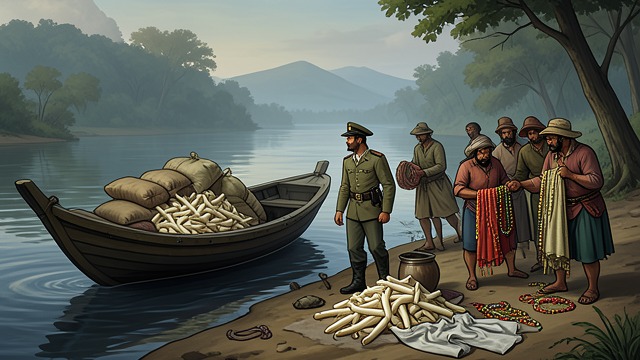
Trade at the Station
Goods Inward
Caravans brought manufactured goods, including cloth, beads, and wire, into the interior. In return, a small flow of Ivory moved outward.
Distorted Priorities
The volume of useless or low-value goods contrasted with the precious commodity the Company sought. Commercial exchange treated the territory as a channel for extraction.
The Human Cost
Marlow saw the trade alongside enslaved and sick workers. Ivory’s value could not be separated from the coercion and suffering supporting its movement.
Kurtz’s Mountain of Ivory
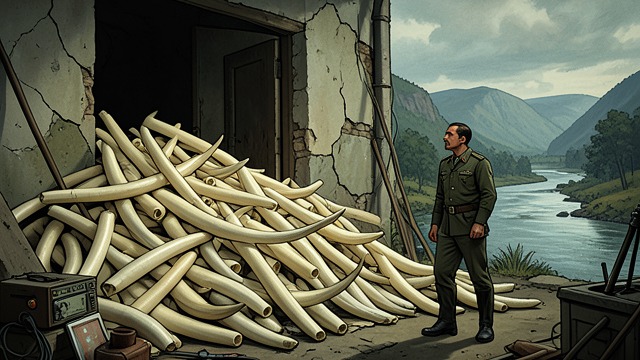
Possession in Excess
A Remarkable Stock
Kurtz had gathered more Ivory than the other agents together. The station’s store of tusks appeared to overwhelm its deteriorating buildings.
A Language of Ownership
Kurtz called the Ivory his own and spoke of the station and river as possessions. His words extended commercial acquisition into a claim over the entire surrounding world.
Success as Corruption
The Ivory marked Kurtz’s power, but not a stable achievement. His accumulation accompanied isolation, violence, and physical decline rather than the promised security of success.
The Company’s Claim
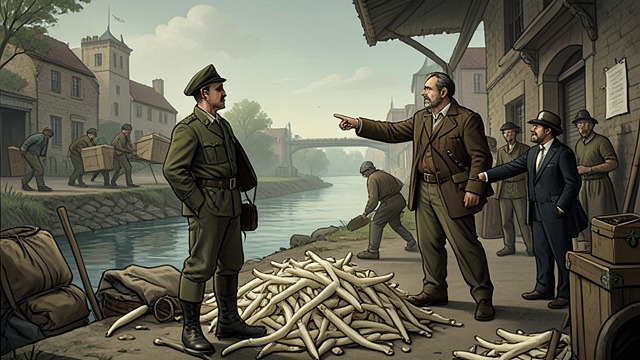
A Dispute over Ownership
Kurtz’s Argument
Kurtz insisted that the Ivory belonged to him because he had collected it at personal risk. He expected the Company to claim it nonetheless.
Competing Rights
His appeal to justice rested on a private claim formed through extraction. The Company’s own right rested on a system of trade that had already shaped his actions.
An Unresolved Question
The dispute made ownership seem inseparable from the methods used to acquire wealth. Kurtz’s protest did not undo the exploitation that made his fortune possible.
Ivory Left Behind
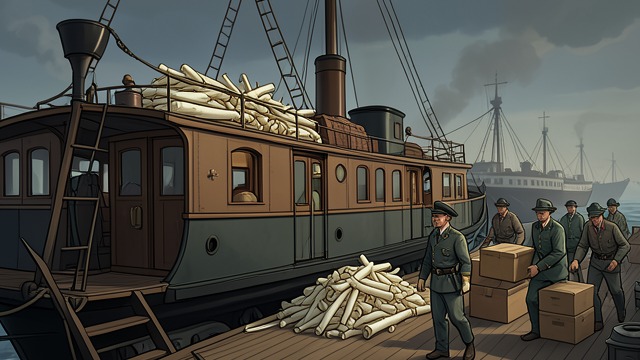
Wealth Without Its Owner
Cargo on the Steamer
Marlow’s party loaded Kurtz’s Ivory aboard, including a great quantity piled on deck. The commodity outlasted the man whose identity had become entangled with it.
A Career’s Remnant
Kurtz had imagined recognition, promotion, and future achievement. In the end, the cargo remained while his body was buried far from the European success he expected.
A Measure of Greed
The Ivory’s survival exposed the durability of the commercial system. One agent’s death did not end the demand that had shaped his conduct and the landscape around him.
When Marlow visits the Company office
During Marlow’s stay at the Outer Station
When Marlow reaches the Inner Station
During the return voyage with Kurtz’s Ivory
After Kurtz’s death
